
Subscription billing in Business Central: how to bill recurring contracts
Share:
It is the end of the month, and your accounting staff are once again facing the following questions:
- Which contracts need to be billed this month?
- When do the various contracts expire?
- Have all recurring invoices been generated?
- How is billing handled for contract changes?
- Is the current contract data up to date?
Anyone offering recurring services — whether IT support, maintenance contracts, or software licences — is familiar with this situation. And they know that without structured processes, billing quickly turns into a time-consuming puzzle of Excel spreadsheets, manual reminders, and improvised workflows.
With the new subscription billing module, Microsoft is closing a gap in the standard functionality of Microsoft Dynamics 365 Business Central. For the first time, recurring contracts can be fully managed within the ERP system — spanning everything from initial setup and automated invoicing to analysis and forecasting.
This means that contract data, billing cycles, and accounting entries are seamlessly integrated, allowing the accounting department to work from the same data set as sales and management accounting. Subscription billing thus becomes an integral part of the financial and operational landscape.
An increasing number of companies are adopting subscription-based business models and deliberately building recurring revenue streams. This so-called ‘subscription economy’ is considered more predictable, stable, and strategically significant than revenue derived solely from projects or products. What once applied primarily to software providers has now firmly taken hold across many industries. Microsoft is responding to this trend by introducing the standard subscription billing module in Microsoft Dynamics 365 Business Central.
The goal is to position Business Central as a fully fledged ERP platform for modern, recurring business models and to expand its functional scope accordingly. Recurring contract billing and revenue recognition based on the correct accounting period are to be handled directly within the core system, rather than via workarounds or external logic.
Microsoft did not start from scratch in this endeavour; the functionality is based on a licensed solution from Singhammer IT Consulting AG, a company that has specialised in subscription-based scenarios for many years. Integrating this solution into the standard product makes this expertise more widely available.
How companies previously billed recurring contracts in Business Central
ERP solutions such as Microsoft Dynamics 365 Business Central initially made billing recurring contracts significantly easier. Features such as recurring journals, sales invoice templates, and service order functionality have long been available in the system and are used by many companies. However, as contracts become more variable, volumes increase, or pro rata billing comes into play, standard solutions often reach their limits. In such cases, Microsoft’s ERP system has frequently been supplemented with third-party solutions — such as CKL Software’s bill-to 365 – as was the case with our project with our customer SmartSim GmbH.
With the new subscription billing module, Microsoft is now bringing these functions directly into the standard version of Business Central for the first time.
This is how the new subscription module in Business Central supports the billing of recurring contracts
The subscription module picks up where previous solutions reached their limits. Instead of relying on workarounds or manual processes, contracts are managed as independent objects within the system, with clear structures and automated processes.
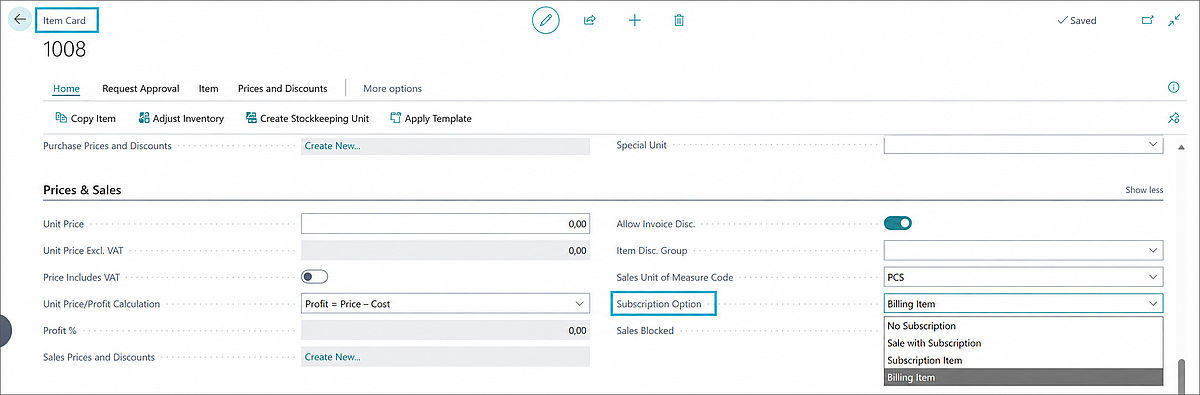
1. Flexible billing cycles for diverse business models
Contracts can be set up with any desired billing interval. Whether for monthly managed services, quarterly maintenance contracts, or annual software licences, invoices are generated automatically at the right time.
Example: An IT service provider manages 80 clients with varying support packages. Some are billed monthly, others quarterly. With subscription billing, all invoices are automatically generated at the correct time.
2. Pro rata billing for contract changes
If the scope of services or prices changes during an active period, the relevant billing periods can be adjusted accordingly. The system then automatically calculates the amounts for the newly defined period.
Example: A customer upgrades their service package on the 15th of the month. If the billing date is adjusted accordingly, subscription billing automatically calculates the pro rata difference without the need for manual calculations or corrections.
3. Unified billing logic for different contract models
Different contract types require different billing models. Subscription billing maps these within the system in a structured manner and ensures that the agreed billing cycles are consistently applied to every invoice.
This keeps billing transparent and standardised, even with mixed contract portfolios — regardless of how many customers or models are active at the same time.
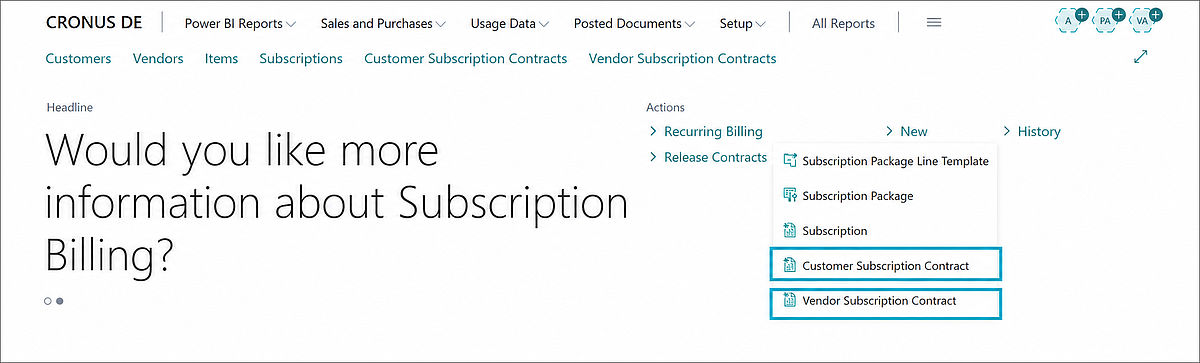
4. Centralised contract overview for the entire term
All contracts can be viewed centrally, including start dates, end dates, notice periods, and current statuses. This means no missed renewals, no ambiguous contract states, and full transparency throughout the entire contract term.
5. Reliable revenue allocation for accounting and management accounting
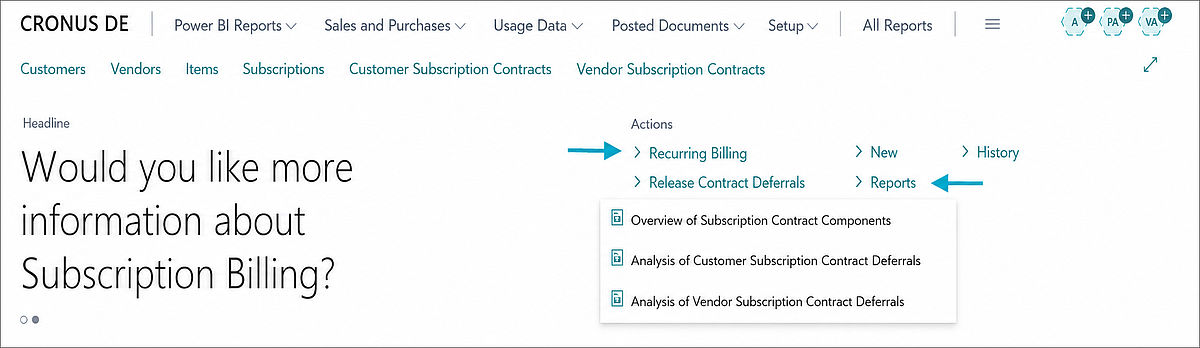
Revenue from recurring contracts is allocated to the appropriate accounting periods. This not only simplifies accounting but also provides the management accounting and leadership teams with a reliable basis for forecasting and liquidity planning.
For the accounting department, this means one thing above all: less manual intervention, reduced reconciliation work, and significantly greater reliability at month-end.
Which companies particularly benefit from the subscription module in Business Central?
Subscription billing is aimed particularly at medium-sized enterprises that bill for services on a regular basis, for example:
- IT service providers offering managed services, cloud hosting, or support contracts
- Maintenance and service providers with regular inspection or servicing contracts
- Software and SaaS companies using licensing or subscription models
- Companies with support contracts for machinery, plant equipment, or technical systems
- Service providers with flat-rate contracts billed on a monthly or annual basis
As the number of contracts grows and terms and billing models become more varied, subscription billing ensures structure and clarity without increasing administrative overhead.
The subscription module offers companies a number of concrete benefits:
- Automated invoicing for recurring services
- Reduced administrative effort for contract changes
- Full transparency regarding contracts, terms, and billing status
- Predictable recurring revenue as a reliable foundation for growth
- Standardised and professional invoicing processes
Does subscription billing replace existing add-ons like bill-to 365?
With the introduction of the subscription billing module, many companies are asking themselves: Will existing add-ons become obsolete?
The answer is not automatically — and not in every scenario.
The standard module in Microsoft Dynamics 365 Business Central reliably covers many classic subscription models — particularly those involving clearly structured, recurring billing with fixed intervals and straightforward contract logic. For many small and medium-sized enterprises, this is perfectly adequate.
However, specialised solutions such as CKL Software’s bill-to 365 go significantly further in certain areas — for example, by handling highly complex, customisable subscription models or meeting specific industry requirements. In such cases, an add-on may still be the right choice.
The crucial question, therefore, is not simply ‘standard module or add-on?’ but rather:
How complex is your business model, and what requirements arise from it?
For many companies, the new module means fewer external dependencies and a clean solution within the standard ERP system. For others, a specialised extension remains the most suitable option.
Subscription billing in Business Central: recurring billing in standard ERP
Recurring contracts are now an integral part of the business model for many companies. However, as the number of contracts rises and complexity increases, so too do the demands for transparency, reliability, and streamlined processes.

The new subscription module transforms Microsoft Dynamics 365 Business Central into a fully fledged platform for recurring billing within the standard system. Contracts, billing cycles, and revenue allocation are integrated in a structured manner. The accounting department gains certainty at month-end, the management accounting team receives reliable figures, and management obtains a stable foundation for predictable revenue. This provides medium-sized companies with exactly the flexibility they need for increasingly complex contract models.
If you would like to determine whether the standard solution is sufficient for your business model or whether a specialised extension would be beneficial, we would be happy to provide you with personalised advice. Please contact us using our contact form.